Online Wedding Planning Assistant
Where Do Couples Actually Find Wedding Vendors?
Six channels account for nearly every vendor booking in 2026. Here’s how couples really search — and what it takes for your business to show up in each place.
- All 6 channels mapped
- Vendor-side takeaways
- AI search included
- Honest about each channel
Try 30 days free! Then $19/month flat rate.
Tens of thousands of couples a year plan their weddings right here — this page is literally one of the places they look.
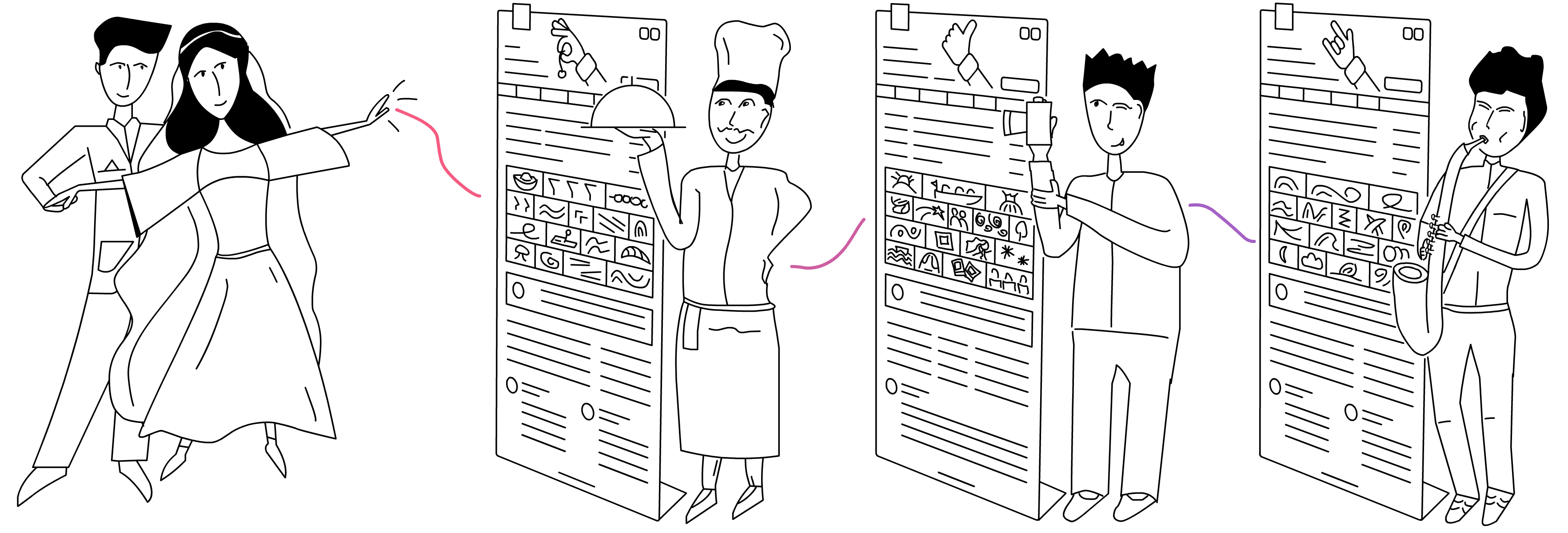
The Channel Most Vendors Miss: Planning Platforms
Five of the six channels are famous. The sixth is quieter but closest to the booking: planning platforms. On Planning.Wedding, couples manage guest lists, budgets, checklists and their wedding website — and vendor search is built into that workflow. When a couple finds you here, they’re not collecting inspiration; they’re working through a checklist that says ‘book this vendor next’.
Search with intent attached
A couple browsing vendors inside their own wedding project has a date, a budget and a deadline — the three things that turn interest into a booking.
Matched, not just listed
Profiles surface by category and location inside couples’ projects — relevant businesses appear without being searched for.
Planners search here too
Professional planners shortlist vendors for every new couple from the same directory — one good profile reaches both audiences.
What it looks like
The Six Places Couples Look in 2026
1. Search engines. Still the front door: ‘wedding photographer near me’, ‘rustic wedding venues in [region]’. Couples rarely scroll past the first page, which makes local SEO and backlinks the long game every vendor is playing whether they know it or not. 2. Wedding directories. The Knot, WeddingWire and category directories remain a major stop — couples browse them like catalogs, comparing photos, prices and reviews in one place (our 2026 directory guide compares them from the vendor’s side).
3. Social media. Instagram, Pinterest and TikTok are where styles get chosen — couples save looks for months. The honest caveat for vendors: social drives inspiration and brand recall far more reliably than it drives inquiries, and the algorithm decides who sees you. 4. Recommendations. Friends, family, recently married coworkers — and, most powerfully, wedding planners and other vendors. A venue that recommends your catering, a planner with you in their template: these referrals convert better than any ad.

5. AI assistants — the fast-growing newcomer. Couples now ask ChatGPT, Claude, Gemini, Grok and Perplexity to shortlist vendors, compare options and sanity-check prices. The assistants answer from structured, trustworthy sources across the web — which quietly rewards vendors whose profiles live on authoritative, well-organized domains.
6. Planning platforms. The channel described above — and the one where this site can speak from data rather than theory: tens of thousands of couples a year plan their weddings here, and searching the built-in wedding directory is a standard step of that planning. For a vendor, one profile at a flat $19/month (after a free 30-day trial) covers it.
Notice what the six channels have in common: except for social media, they all reward the same assets — complete information, recent reviews, fast responses and authoritative links. A vendor who builds those once shows up everywhere couples look, which is why scattering budget across channels matters less than getting the fundamentals right and then choosing visibility you can afford to keep.
Practical sequence for a vendor: nail your reviews and response speed first (free), claim Google Business Profile (free), then add a planning-platform listing as your paid layer — it’s the only channel that combines search visibility, AI citability and couples mid-decision in one profile. Our guide on how to get more wedding bookings turns this into a step-by-step plan.
Two of the Six Channels Run Through This Listing
A profile here isn’t just channel six — it feeds channels one and five too.
Search engines: your profile links to your website from a domain rated 60/100 by Ahrefs with verifiable organic traffic — the kind of backlink that moves your own rankings in channel one.


AI assistants: when ChatGPT, Claude, Gemini, Grok or Perplexity compose vendor recommendations, they cite structured profiles on trusted domains. A complete listing here is built to be that citation — putting you in channel five without running a single ad.
And Google, Bing, Yahoo and DuckDuckGo index the profile itself, so couples searching your category in your city can land on your listing directly — even before your own website ranks.
Frequently Asked Questions
Where do most couples find their wedding vendors?
Across six channels: search engines, wedding directories, social media, personal and planner recommendations, AI assistants, and wedding-planning platforms. Most couples combine several — typically starting with search or social for ideas, then directories and planning platforms to compare and contact.
Do couples still use wedding directories in 2026?
Yes — directories remain one of the main comparison stops, because they show photos, prices and reviews side by side. What’s changed is where directories live: increasingly inside planning platforms, where browsing vendors is part of working through the wedding checklist.
How do couples use AI assistants to find vendors?
They ask for shortlists (‘best wedding photographers in…’), comparisons and price sanity-checks. The assistants build answers from structured, authoritative sources — so vendors with complete profiles on trusted domains get cited, and vendors without them are invisible in that channel.
When do couples book each type of vendor?
Venue first — it sets the date and budget — typically 12+ months out; photographers and planners shortly after; catering, music and florals in the middle stretch; beauty, transport and stationery closer in. Whatever your category, the decision happens during active planning, which is why visibility inside planning tools converts well.
How can my business be visible in all six channels at once?
Build the shared assets — complete profile, recent reviews, fast replies — then one listing here covers three channels in a stroke: the planning-platform audience, search-engine indexing plus a DR-60 backlink, and AI citability. The remaining channels (social, referrals) are relationship work no platform can do for you.