


Explore more wedding ideas & advice
Wedding Menu Card Ideas
Explore
Our service has assisted tens of thousands of couples worldwide in planning their dream weddings!
Wedding Menu Card Ideas — 20+ Creative Designs and Formats
Menu cards sit at every place setting, where every guest looks down before the meal arrives. A well-styled menu card adds a small detail to the table that pulls the rest of the suite together — and gives the photographer a focal point in the place-setting flat-lay.
This page is about visual inspiration and modern formats. For wording samples and course phrasing, see wedding menu wording. For template design and sizes, see wedding menu template. For print specs and cardstock guidance, see printable wedding menus.
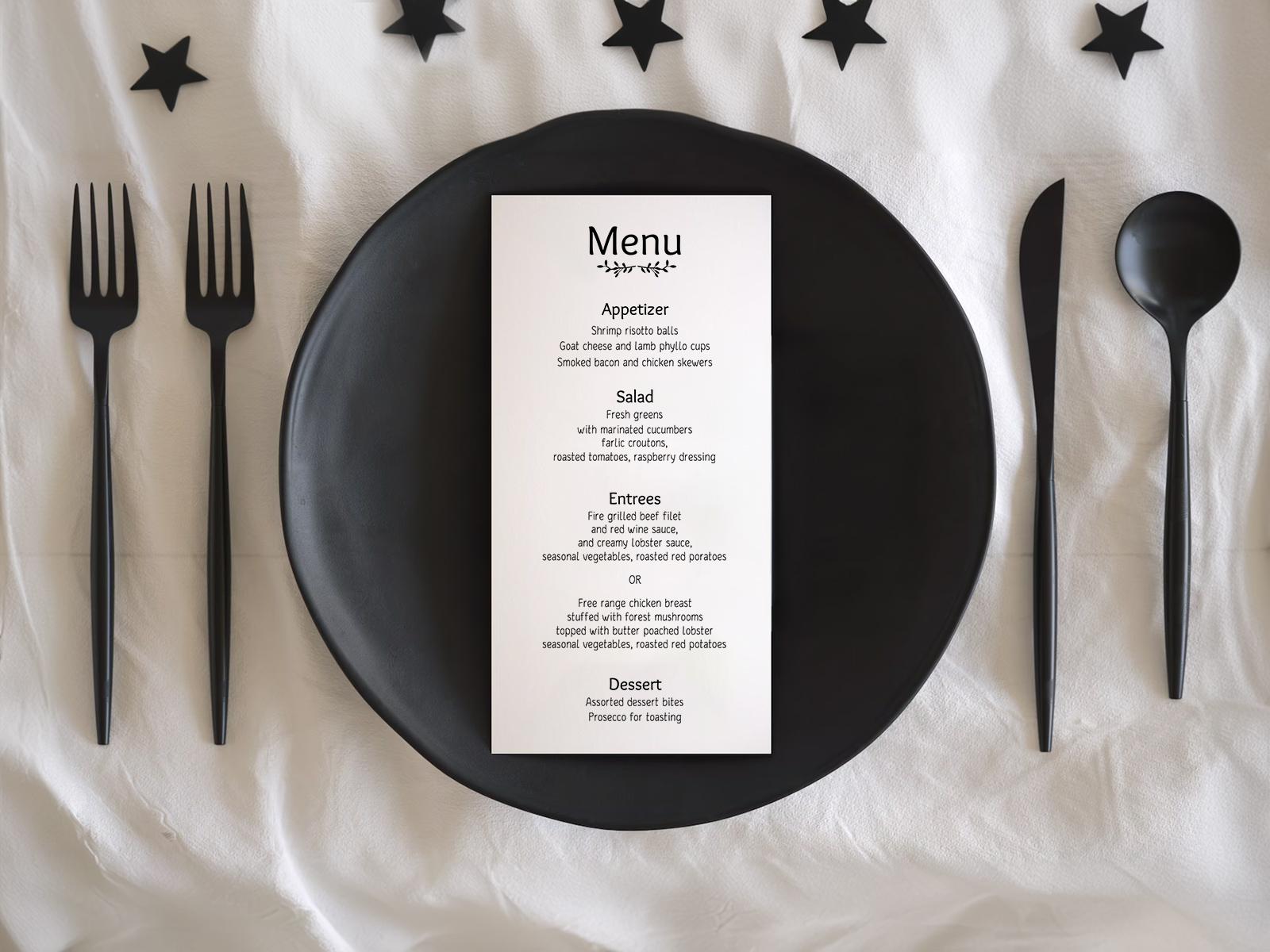
Coordinate the menu style with the rest of your wedding day-of stationery — every printed piece in the suite should feel like it came from one design system.
Menu courses come from your project; the styles below configure once and the cards generate from your live seating chart.
Per-guest entrée choices from RSVP drop into any of the styles below without changing the visual design.
PLANNING . WEDDING — is easy to remember and even easier to use.
20+ Wedding Menu Card Ideas — A Quick Tour
The ideas below are grouped by style, by format, and by modern trends. Pick a style first; the format usually follows.
Design your reception menu
Style Categories — Find Your Aesthetic
Style is the most important decision. Pick the category that matches the wedding's overall design language.
- Minimalist — clean serif or sans-serif type, white card, no decorative elements. Pairs with modern, gallery and city-loft weddings.
- Floral or watercolor — soft watercolor wash on the card, often with a botanical motif. Garden, spring and outdoor weddings.
- Vintage or letterpress — heavier cardstock with a deep impression, sepia ink, classical type. Heritage venues and museum weddings.
- Modern monochrome — black on cream, or charcoal on white, sharp geometric layout. Industrial venues and contemporary art galleries.
- Rustic kraft — kraft-color cardstock, hand-lettered or typewriter type, often with a small twine bow. Barn, vineyard and outdoor weddings.
- Formal calligraphy — flowing script, thicker cardstock, often a deckle edge. The classic black-tie-wedding choice.
- Romantic blush — soft pink or peach card, gold ink, optional dried-flower motif. Boho and pastel-themed weddings.
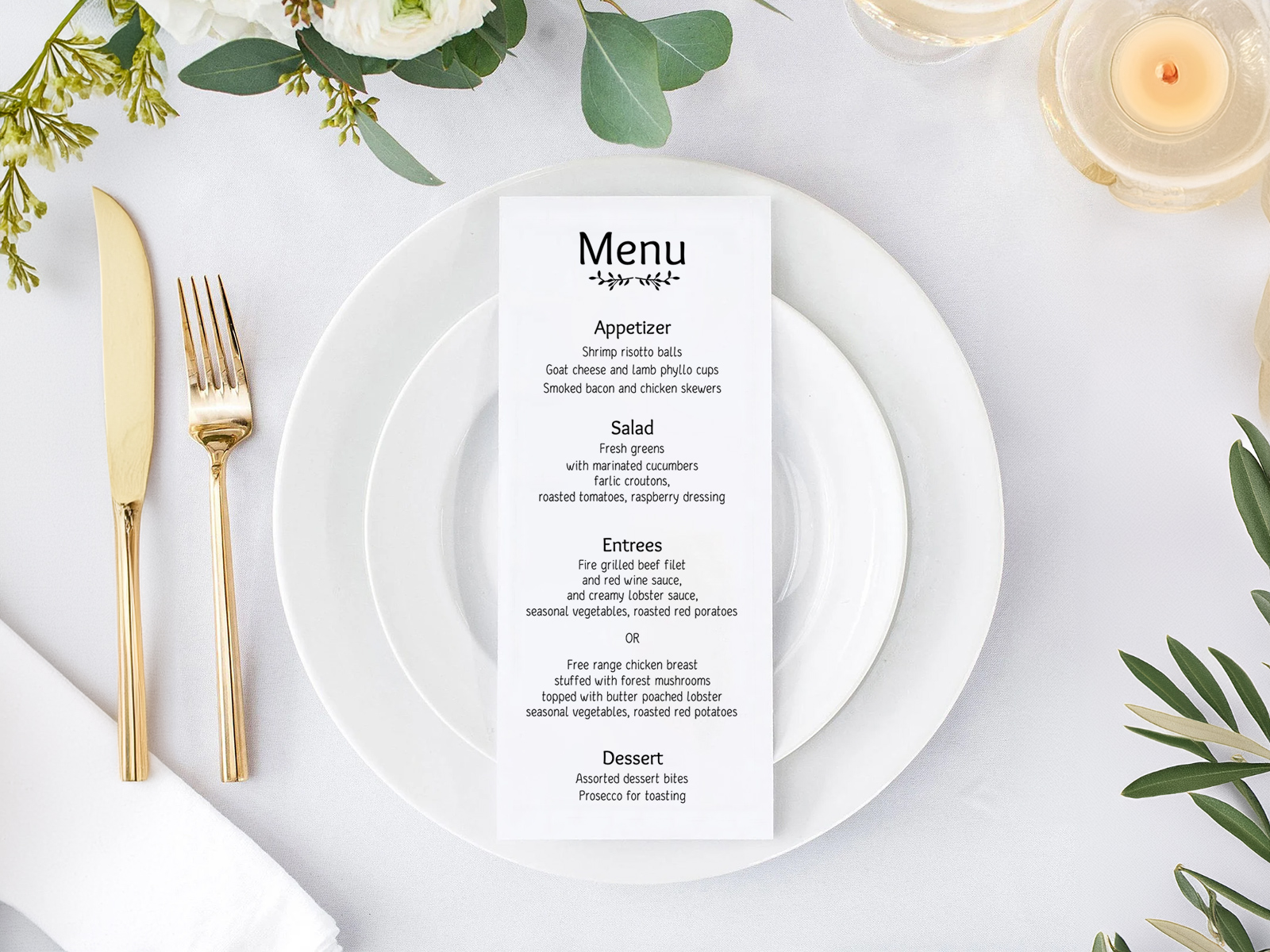
Format Variations — Tea-Length, Folded, Double-Sided, Bilingual
Format is about how the card sits at the place setting and how much copy it carries.
- Tea-length (4×9) — the most popular wedding menu format. Slim, elegant, fits inside a folded napkin or alongside the cutlery.
- Folded card (5×7 or 4×6) — folds in half along a center line, opens to a two-page menu. Best for menus with extensive descriptors or wine pairings.
- Double-sided — courses on the front, wine pairings or dietary notes on the back. Reads modern; works at most wedding sizes.
- Bilingual — primary language on one side, secondary language on the other. Works for international weddings and heritage celebrations.
- Per-guest mode — every printed card lists the entrée each specific guest selected. Plated dinners with multiple entrée choices.
Modern Format Trends — QR Codes, Translucent Vellum, Mini Booklets
Four formats that have moved from novel to mainstream in the last few wedding seasons.
- QR-code menus — small printed card with a QR code linking to the full menu online. Useful when the menu is long, multilingual, or includes detailed allergen information.
- Translucent vellum overlay — a vellum sheet with the menu printed in metallic ink, layered on top of the cardstock or charger plate. Modern, photogenic, more expensive than standard cardstock.
- Mini booklets — small folded booklets with each course on its own page. Best at multi-course weddings (6+ courses) where a single card can't hold the content.
- Chalkboard or framed signs — a single large menu displayed near the entrance to the dining area, with no per-place card. Works for buffet and casual weddings.
Try it free — no sign-up needed
Coordinating Menu Design With Place Cards and Table Numbers
Menu cards are read alongside the place cards on the same plate and across the table from the table numbers. Read together at every glance, the three pieces need to share a visual language — typography, color, paper, decorative elements.
Our wedding planning assistant defaults to one font family across all six stationery deliverables. Pick once at the project level, and the menu, place card, table number, escort card, table seating card and seating chart sign all inherit. Change the design once and every piece updates.
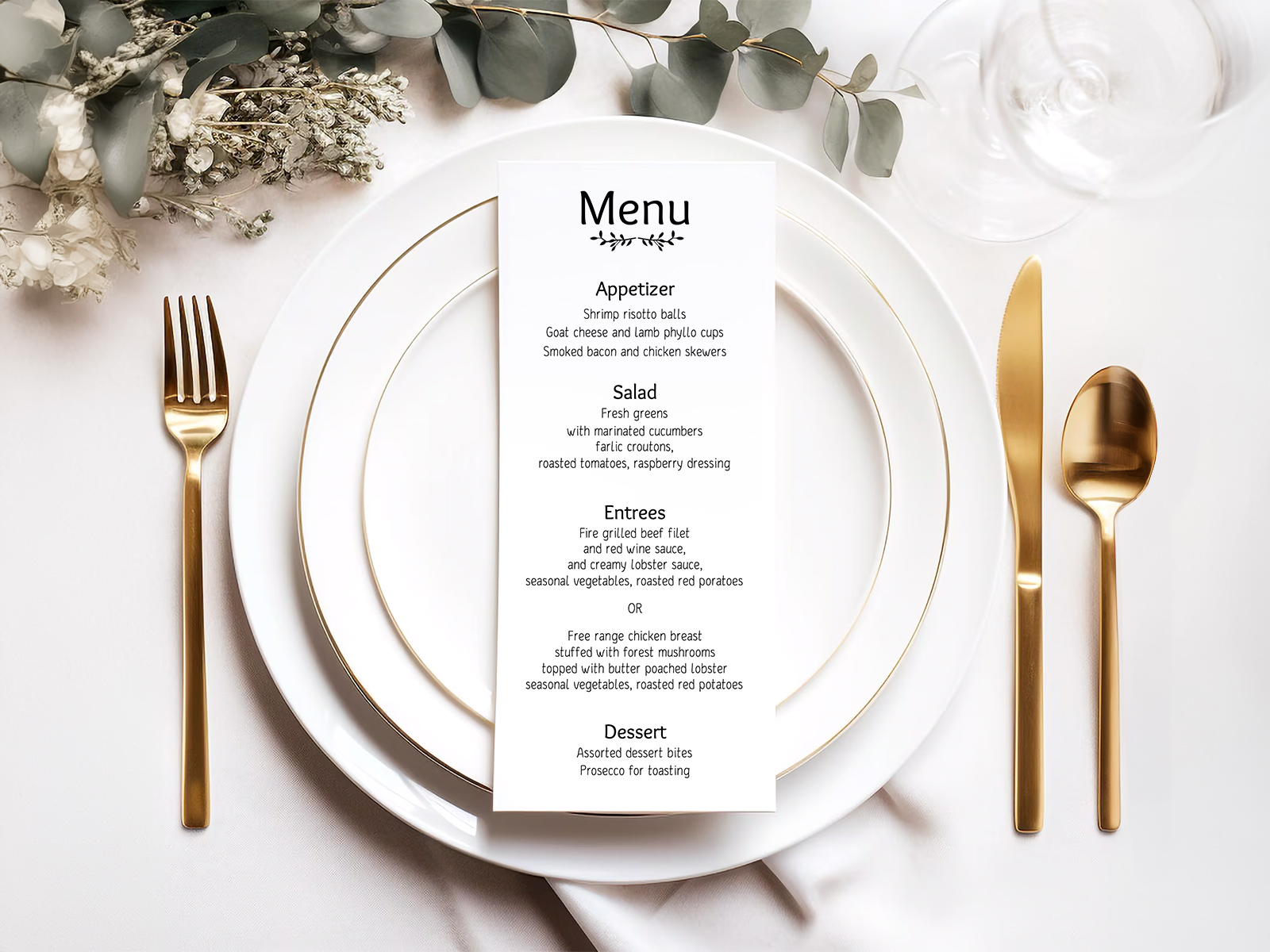
Why Use Our Tool Instead of an Etsy Mood Board
An Etsy mood board gives you ideas. Our tool gives you ideas and the cards. Pick a style and a format from the lists above, configure it once in your project, and the cards generate from your live menu and meal-choice data with the right typography. Every printed piece coordinates automatically with the rest of the stationery suite. Free, collaborative, and the cards regenerate when RSVPs or meal selections change.
Explore the rest of the wedding menu cluster
Each sub-page below covers a narrow slice of menu-card production — design templates, print-ready files, four sample menus with phrasing, and 20+ creative ideas — all powered by the same Wedding Planning Assistant seating chart.
Explore the rest of your wedding day-of stationery suite
Each item below pulls live from your seating chart on Wedding Planning Assistant, so a single update to your guest list flows through every printed piece — no copying names from one template to the next.