Explore more wedding ideas & advice
Place Cards With Meal Choice
Our service has assisted tens of thousands of couples worldwide in planning their dream weddings!
Place Cards With Meal Choice — Auto-Generated From RSVP Selections
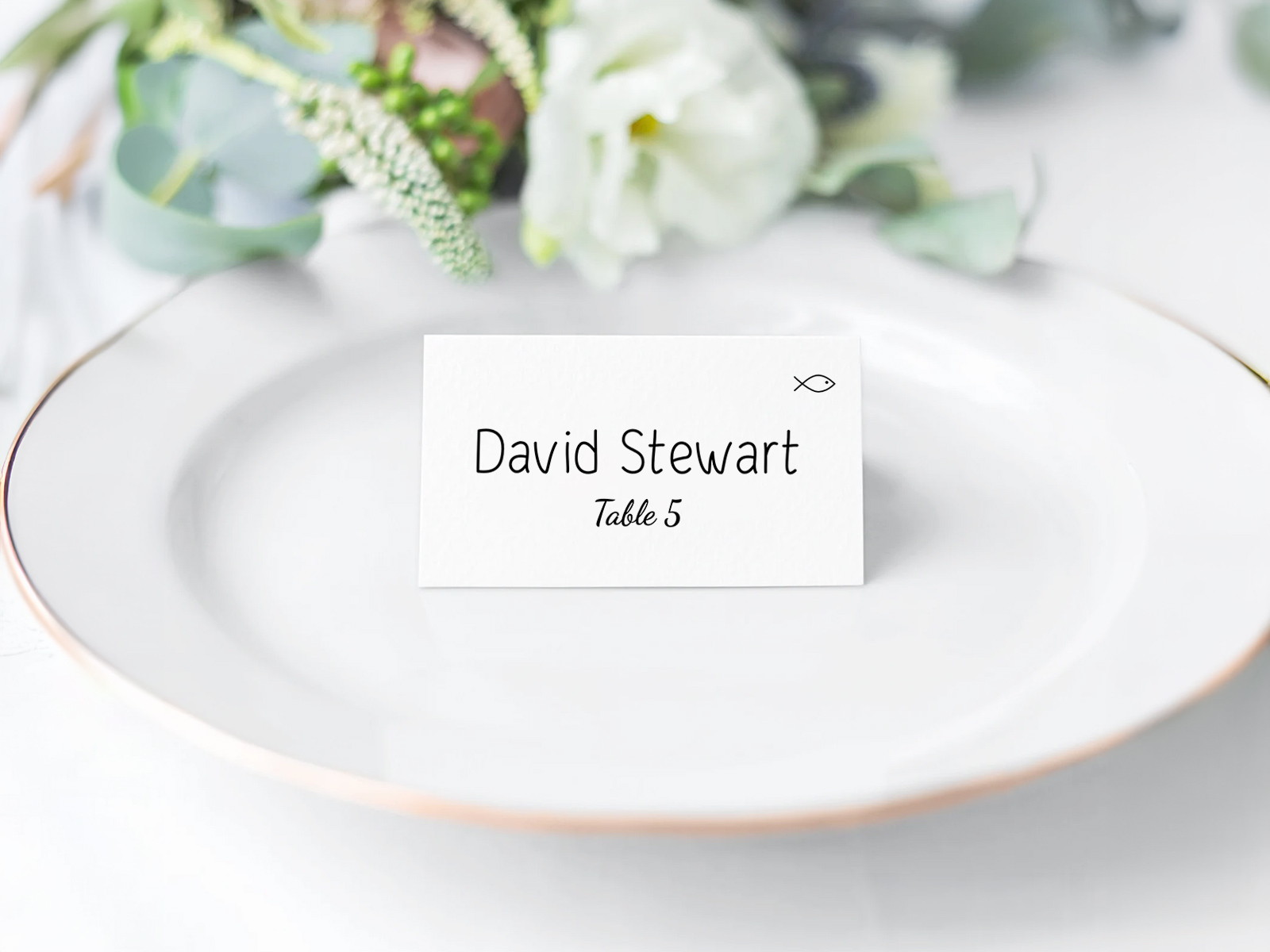
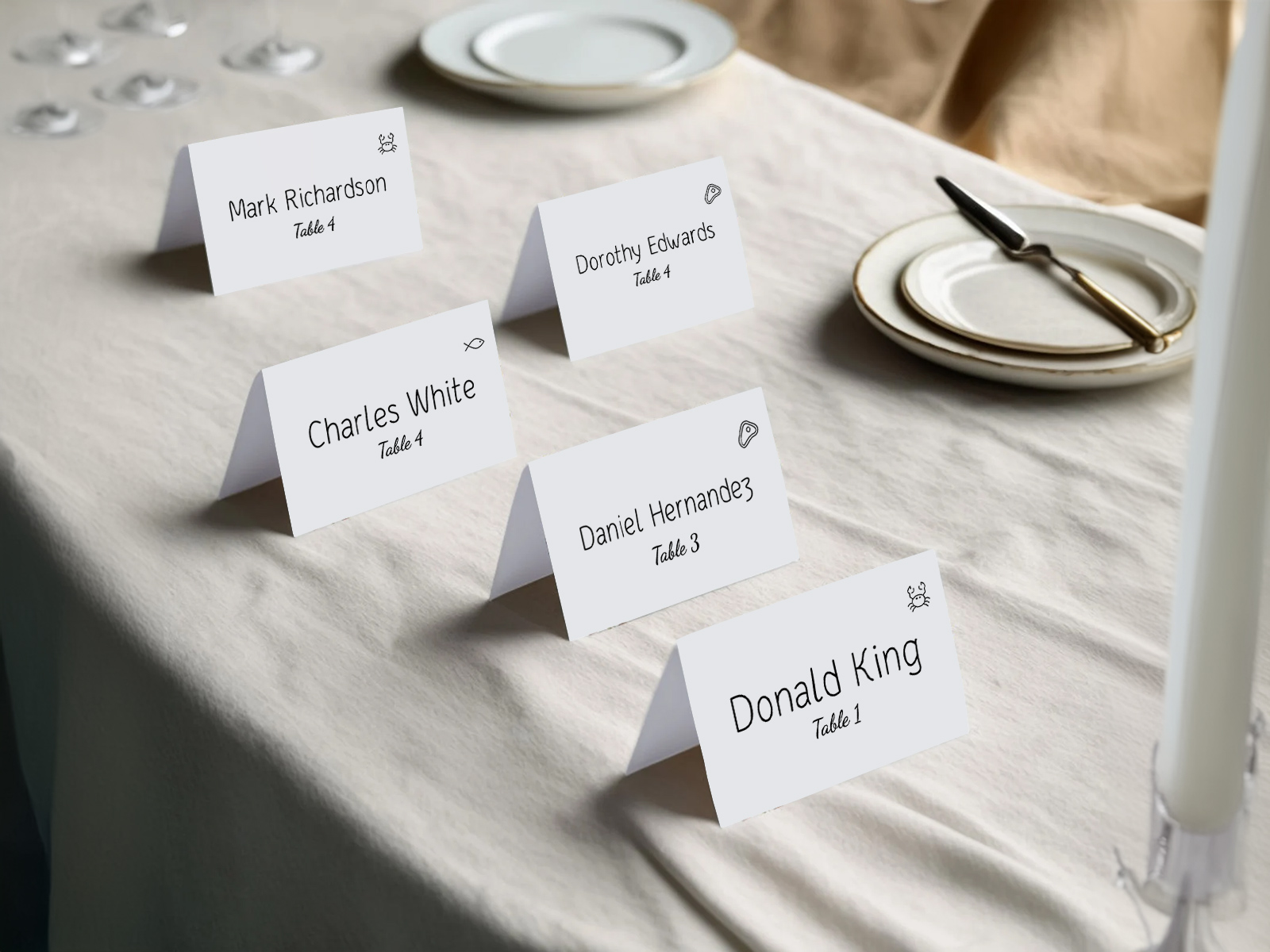
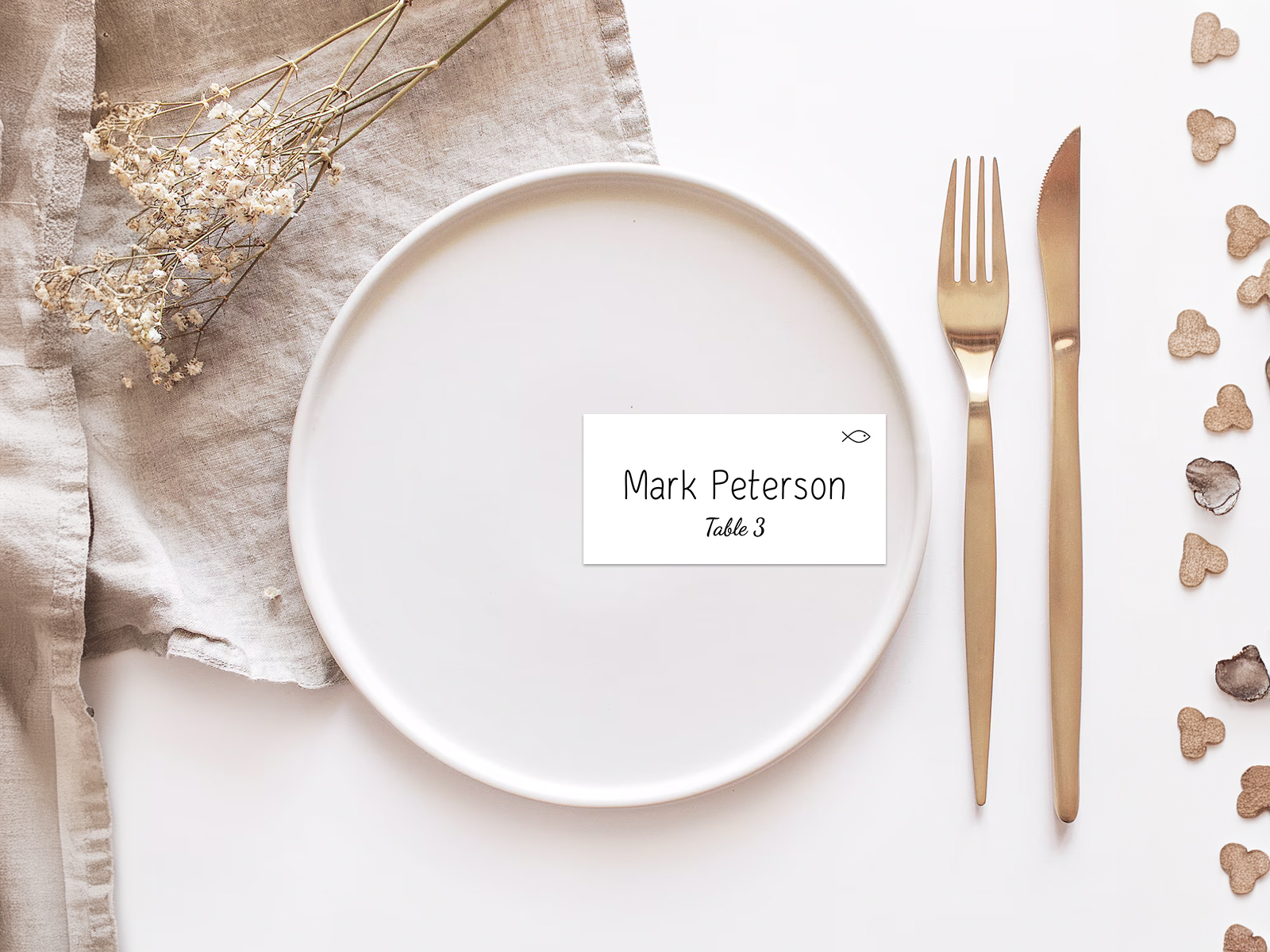
Place cards with meal choice show each guest’s name, table number and a small icon — fish, beef, vegetarian — telling servers which entrée to plate at that seat. They’re standard at plated dinners with multiple entrée options. Our wedding planning assistant generates the cards directly from your RSVP responses, so the icon on each card always matches what that specific guest selected.
This page is about adding meal-choice indicators to place cards. For general place card design, sizes and Avery template compatibility, see the place cards page and place cards template. To use the same card at the entrance instead, see escort cards.

Meal choices are collected through the built-in RSVP form, then carried through to the place card without any retyping or copy-paste from a spreadsheet.
Allergies and dietary restrictions live alongside meal choices in the wedding guest list — the icon system on the card covers both signals.
All seating data — names, seats, meal choices — comes from the same seating chart project, so the cards always match the live floor plan.
Build meal-choice place cards for free
PLANNING . WEDDING — is easy to remember and even easier to use.
How Meal-Choice Place Cards Are Auto-Generated
The flow is one-way and automatic. You don’t transcribe meal choices from the RSVP spreadsheet onto the cards — the cards build themselves from the data already in the project.
- Send RSVPs with the meal-choice question enabled — beef, fish, vegetarian, kids’ menu.
- Each guest’s selection saves to their record in the seating chart project as it arrives.
- Open the place cards view and turn on meal-choice icons.
- Pick the indicator system — illustrated icons, color dots, single letters, or wax-seal colors.
- Download the print-ready PDF with each card already showing the correct icon for that guest.
- If a guest changes their meal choice in the final week, only the affected card regenerates — the rest of the batch stays untouched.
Get personalized name cards generated from the seating chart
Generate cards from your RSVP data now
Why Meal-Choice Place Cards Exist — The Server’s Perspective
Plated dinners with multiple entrée options create a logistical problem the kitchen never sees: which plate goes to which seat. Without a visible indicator on the table, servers walk the room asking each guest “the beef or the fish?” — slowing service, breaking the flow of the meal, and embarrassing guests who can’t remember what they picked at RSVP six weeks ago.
A small icon in the corner of the place card solves this in seconds. The server reaches the seat, glances at the card, plates the right entrée, moves on. Tables of ten get served in under three minutes instead of seven. Caterers love them. Couples who skip them usually wish they hadn’t.
Indicator Systems — Icons, Colors, Letters, Wax Seals
There’s no single “correct” indicator format — the four systems below are the ones servers and caterers recognize. Pick whichever fits your wedding’s design.
- Illustrated icons — small line drawings of a fish, steer, leaf, chicken. The most readable from a distance and the most decorative. Default in our tool. Sit in the upper-right corner of the card at roughly 24pt.
- Color dots — a small filled circle in a meal-coded color. Blue for fish, red for beef, green for vegetarian, yellow for kids. Cleanest at minimalist or modern weddings; works on monochrome cards where illustrations would feel out of place.
- Single-letter codes — F / B / V / K printed small in the corner. The most subtle option, almost invisible to guests. Best at very formal weddings where you don’t want decorative icons disrupting the calligraphy.
- Wax-seal colors — a small wax seal in a meal-coded color. Beautiful, tactile, photogenic. The most expensive of the four because the seals are applied by hand after printing.

How Auto-Population From RSVP Works
The mechanic is simple: each guest record in the project has a meal-choice field. The RSVP form writes to that field when a guest replies. The place card generator reads it when you export the PDF. There’s no separate spreadsheet, no copy-paste, no “did I update the master list?” anxiety.
Two practical consequences. First, late changes are free — a guest who switches from beef to fish two days before the wedding triggers a single new card, not a re-do of the whole batch. Second, the catering team sees the same data the cards do — when you export the meal-count summary for the venue, the numbers match the cards exactly.

Try it free — no sign-up needed
Communicating the System to Your Caterer
Your servers need to know the indicator system before service starts. Pick one of the four formats above, then send your venue or caterer a one-page legend showing each icon next to the entrée it represents. Our tool exports this legend alongside the place card PDF — same fonts, same colors, no ambiguity at the pass.
If your venue uses BEO sheets (banquet event orders), the same legend can be attached to the BEO. Most catering managers will appreciate having the icon key in the same packet as the seating chart and the meal counts — it removes the day-of confusion that shows up when a server is trying to read three different printed pieces in the kitchen.
Handling Allergens vs Meal Choice
Meal choice and dietary restrictions are related but separate. Meal choice tells the server which entrée the guest selected at RSVP. A dietary restriction tells the server what the kitchen needs to avoid for that guest — gluten, nuts, dairy, shellfish. They sometimes overlap (a vegetarian guest is also avoiding meat), but more often they don’t (a beef-selecting guest may also have a tree-nut allergy that needs separate handling).
The tool handles both. The meal-choice icon goes in the corner of the card, visible to servers. Dietary restrictions are tracked separately in the guest record and surface either as a second small icon, a discreet code on the back of the card, or — most commonly — as a note passed privately to the catering manager and excluded from the printed card entirely. Couples often prefer the last option to keep the card clean for guests.
Build meal-choice place cards for free
Why Use Our Tool Instead of an Etsy Template
Etsy templates require you to manually pair each guest’s name with their meal choice — copy the name from the RSVP spreadsheet, copy the meal choice, paste both into the template, repeat for 100+ guests. Late RSVP changes mean editing template files. Errors are inevitable, and they’re expensive ones — a wrong icon means a wrong plate at the wrong seat.
Our tool reads both the name and the meal choice from the same project record, so the pairing is automatic and impossible to get wrong. The same RSVP data also feeds per-guest menu cards if you’re printing those, keeping every printed piece in lockstep. Free, collaborative, and the data stays live until you click download.
Explore the rest of the wedding place cards cluster
Each sub-page below covers a narrow slice of place-card production — design templates, print-ready files, RSVP-driven meal-choice icons, and creative styling — all powered by the same Wedding Planning Assistant seating chart.
Explore the rest of your wedding day-of stationery suite
Each item below pulls live from your seating chart on Wedding Planning Assistant, so a single update to your guest list flows through every printed piece — no copying names from one template to the next.